What We Believe
Articles of Faith
What Do Presbyterians Believe? Sermon by Rev. Dr. Bob Simmons
Apostle’s Creed
I believe in God, the Father almighty,
creator of heaven and earth.
I believe in Jesus Christ, his only Son, our Lord,
who was conceived by the Holy Spirit
and born of the virgin Mary.
He suffered under Pontius Pilate,
was crucified, died, and was buried;
he descended to hell.
The third day he rose again from the dead.
He ascended to heaven
and is seated at the right hand of God the Father almighty.
From there he will come to judge the living and the dead.
I believe in the Holy Spirit,
the holy catholic* church,
the communion of saints,
the forgiveness of sins,
the resurrection of the body,
and the life everlasting. Amen.
*that is, the true Christian church of all times and all places
This creed is called the Apostles’ Creed not because it was produced by the apostles themselves but because it contains a brief summary of their teachings. It sets forth their doctrine “in sublime simplicity, in unsurpassable brevity, in beautiful order, and with liturgical solemnity.” In its present form it is dated no later than the fourth century. More than any other Christian creed, it may justly be called an ecumenical symbol of faith. This translation of the Latin text was approved by the CRC Synod of 1988.
Nicene Creed
the Father almighty,
maker of heaven and earth,
of all things visible and invisible.
the only Son of God,
begotten from the Father before all ages,
God from God,
Light from Light,
true God from true God,
begotten, not made;
of the same essence as the Father.
Through him all things were made.
For us and for our salvation
he came down from heaven;
he became incarnate by the Holy Spirit and the virgin Mary,
and was made human.
He was crucified for us under Pontius Pilate;
he suffered and was buried.
The third day he rose again, according to the Scriptures.
He ascended to heaven
and is seated at the right hand of the Father.
He will come again with glory
to judge the living and the dead.
His kingdom will never end.
the Lord, the giver of life.
He proceeds from the Father and the Son,
and with the Father and the Son is worshiped and glorified.
He spoke through the prophets.
We believe in one holy catholic and apostolic church.
We affirm one baptism for the forgiveness of sins.
We look forward to the resurrection of the dead,
and to life in the world to come. Amen.
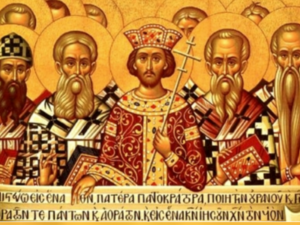
The Nicene Creed, also called the Nicaeno-Constantinopolitan Creed, is a statement of the orthodox faith of the early Christian church in opposition to certain heresies, especially Arianism. These heresies, which disturbed the church during the fourth century, concerned the doctrine of the trinity and of the person of Christ. Both the Greek (Eastern) and the Latin (Western) church held this creed in honor, though with one important difference: the Western church insisted on the inclusion of the phrase “and the Son” (known as the “filioque”) in the article on the procession of the Holy Spirit; this phrase still is repudiated by the Eastern Orthodox church. In its present form this creed goes back partially to the Council of Nicea (A.D. 325) with additions by the Council of Constantinople (A.D. 381). It was accepted in its present form at the Council of Chalcedon in 451, but the “filioque” phrase was not added until 589. However, the creed is in substance an accurate and majestic formulation of the Nicene faith. This translation of the Greek text was approved by the CRC Synod of 1988.
Athanasian Creed
neither blending their persons
nor dividing their essence.
For the person of the Father is a distinct person,
the person of the Son is another,
and that of the Holy Spirit still another.
But the divinity of the Father, Son, and Holy Spirit is one,
their glory equal, their majesty coeternal.
The Father is uncreated,
the Son is uncreated,
the Holy Spirit is uncreated.
the Son is immeasurable,
the Holy Spirit is immeasurable.
the Son is eternal,
the Holy Spirit is eternal.
there is but one eternal being.
So too there are not three uncreated or immeasurable beings;
there is but one uncreated and immeasurable being.
the Son is almighty,
the Holy Spirit is almighty.
Yet there are not three almighty beings;
there is but one almighty being.
the Son is God,
the Holy Spirit is God.
Yet there are not three gods;
there is but one God.
the Son is Lord,
the Holy Spirit is Lord.
Yet there are not three lords;
there is but one Lord.
to confess each person individually
as both God and Lord,
so catholic religion forbids us
to say that there are three gods or lords.
The Son was neither made nor created;
he was begotten from the Father alone.
The Holy Spirit was neither made nor created nor begotten;
he proceeds from the Father and the Son.
there is one Son, not three sons;
there is one Holy Spirit, not three holy spirits.
nothing is greater or smaller;
in their entirety the three persons
are coeternal and coequal with each other.
we must worship their trinity in their unity
and their unity in their trinity.
should think thus about the trinity.
that one also believe in the incarnation
of our Lord Jesus Christ faithfully.
that our Lord Jesus Christ, God’s Son,
is both God and human, equally.
begotten before time;
and he is human from the essence of his mother,
born in time;
completely God, completely human,
with a rational soul and human flesh;
equal to the Father as regards divinity,
less than the Father as regards humanity.
yet Christ is not two, but one.
He is one, however,
not by his divinity being turned into flesh,
but by God’s taking humanity to himself.
He is one,
certainly not by the blending of his essence,
but by the unity of his person.
For just as one human is both rational soul and flesh,
so too the one Christ is both God and human.
he descended to hell;
he arose from the dead;
he ascended to heaven;
he is seated at the Father’s right hand;
from there he will come to judge the living and the dead.
At his coming all people will arise bodily
and give an accounting of their own deeds.
Those who have done good will enter eternal life,
and those who have done evil will enter eternal fire.
one cannot be saved without believing it firmly and faithfully.
 Background
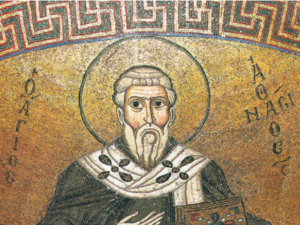
This creed is named after Athanasius (A.D. 293-373), the champion of orthodoxy against Arian attacks on the doctrine of the trinity. Although Athanasius did not write this creed and it is improperly named after him, the name persists because until the seventeenth century it was commonly ascribed to him. It is not from Greek (Eastern), but from Latin (Western) origin, and is not recognized by the Eastern Orthodox Church today. Apart from the opening and closing sentences, this creed consists of two parts, the first setting forth the orthodox doctrine of the trinity, and the second dealing chiefly with the incarnation and the two-natures doctrine. This translation was adopted by the CRC Synod of 1988.